Cengage Medical
Designing an AI Patient Simulation for Clinical Skills Training
UX + AI Design
Episode 1: The Brief
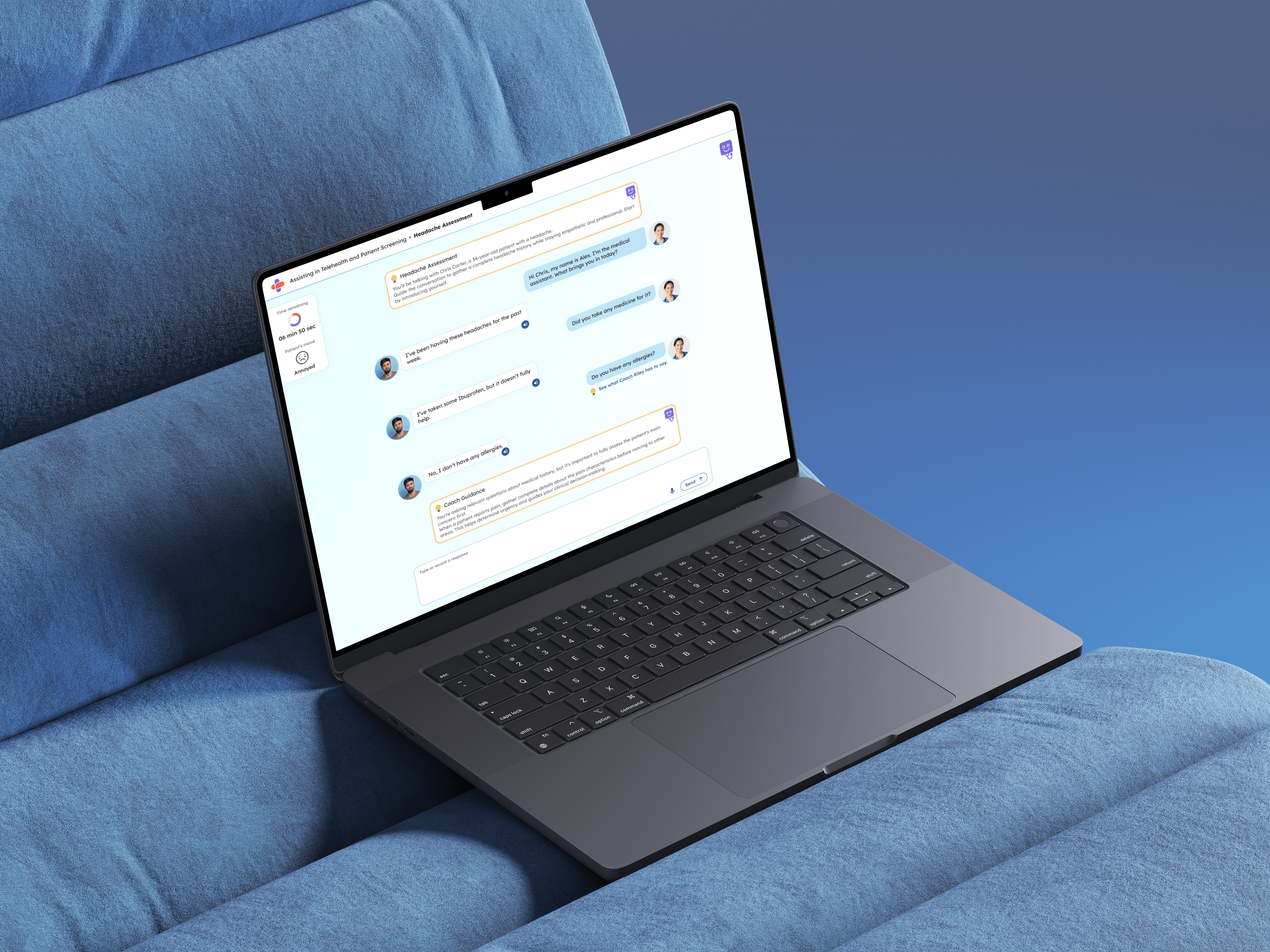
Cengage wanted to explore how AI could transform clinical skills for medical assisting students by helping them practice patient screening.
The goal was to help students apply theoretical knowledge in real-world scenarios using AI to provide real-time feedback and reinforce learning. The ask was a proof of concept: something concrete enough for stakeholders to evaluate and guide a build decision.
I was the sole designer on this simulation where a student plays the role of a medical assistant, interviewing an AI patient, guided by an AI coach who intervenes only when needed.
Episode 2: Discovery
Discovery: What does a structured literacy program actually need?
The core design question was behavioral. How does a coaching system know when to speak and when to stay quiet?
I identified two possibilities from the start:
Too much coaching - the student feels surveilled. They stop thinking clinically and start trying to please the coach. The simulation becomes a guessing game, not a learning experience.
Too little coaching - students with real knowledge gaps get lost. They repeat mistakes, grow frustrated, and learn nothing from the experience.
/
Episode 3: The System
The simulation runs on two AI characters and three possible learning paths.
AI Patient
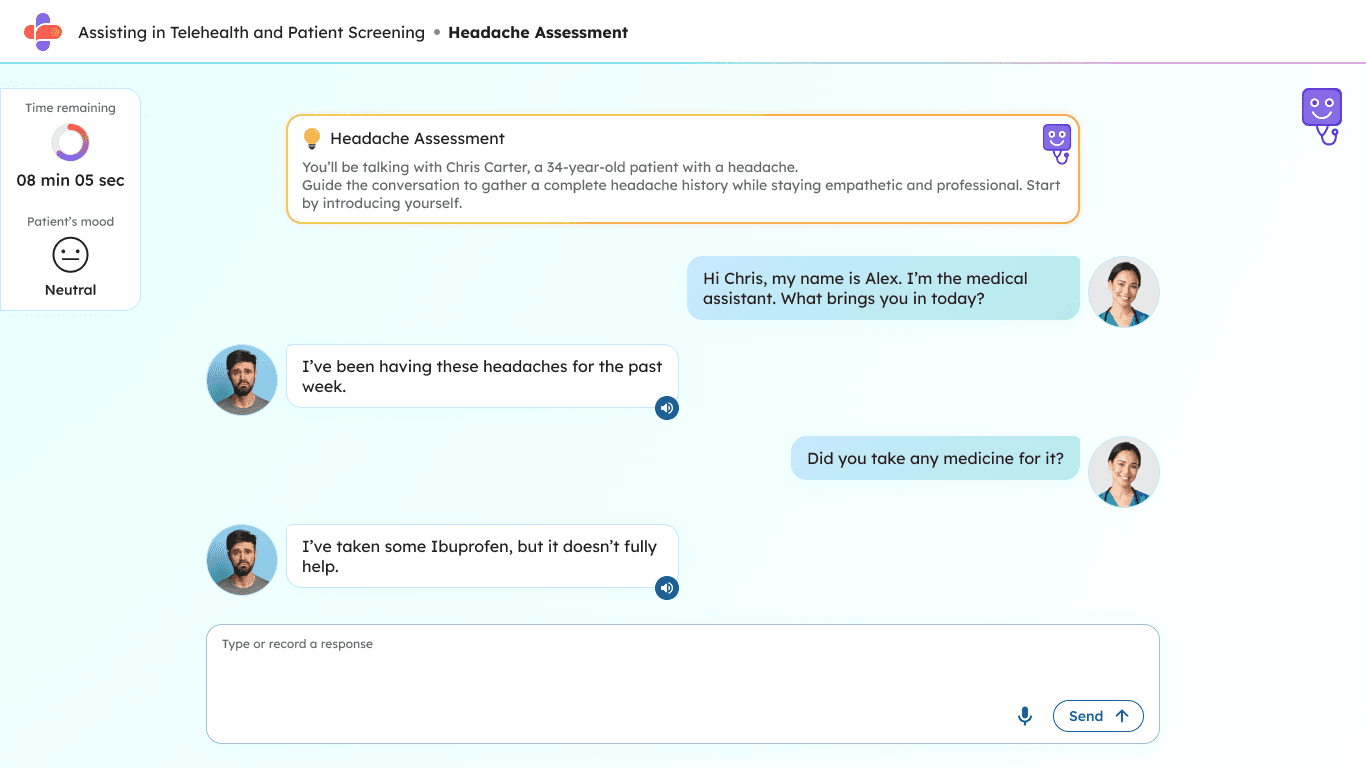
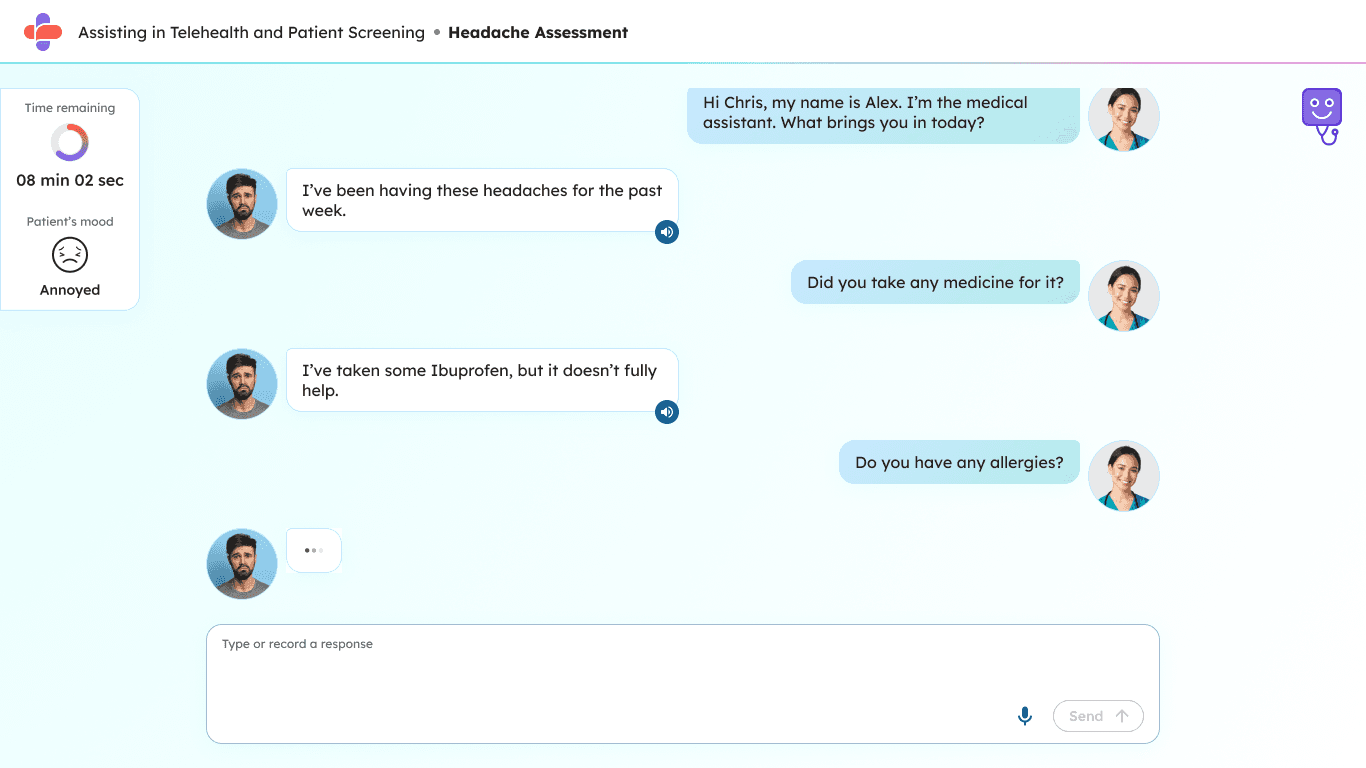
A patient presents with a problem. The patient responds dynamically to how the student conducts the interview. The mood is tracked visibly on the left panel which starts at Neutral. Ask questions in the wrong order and they become Annoyed. Handle the conversation well and they stay cooperative.
The mood system isn't decorative. It teaches students that clinical communication is bidirectional - patients react to how they're treated, not just what they're asked.
Coach Riley
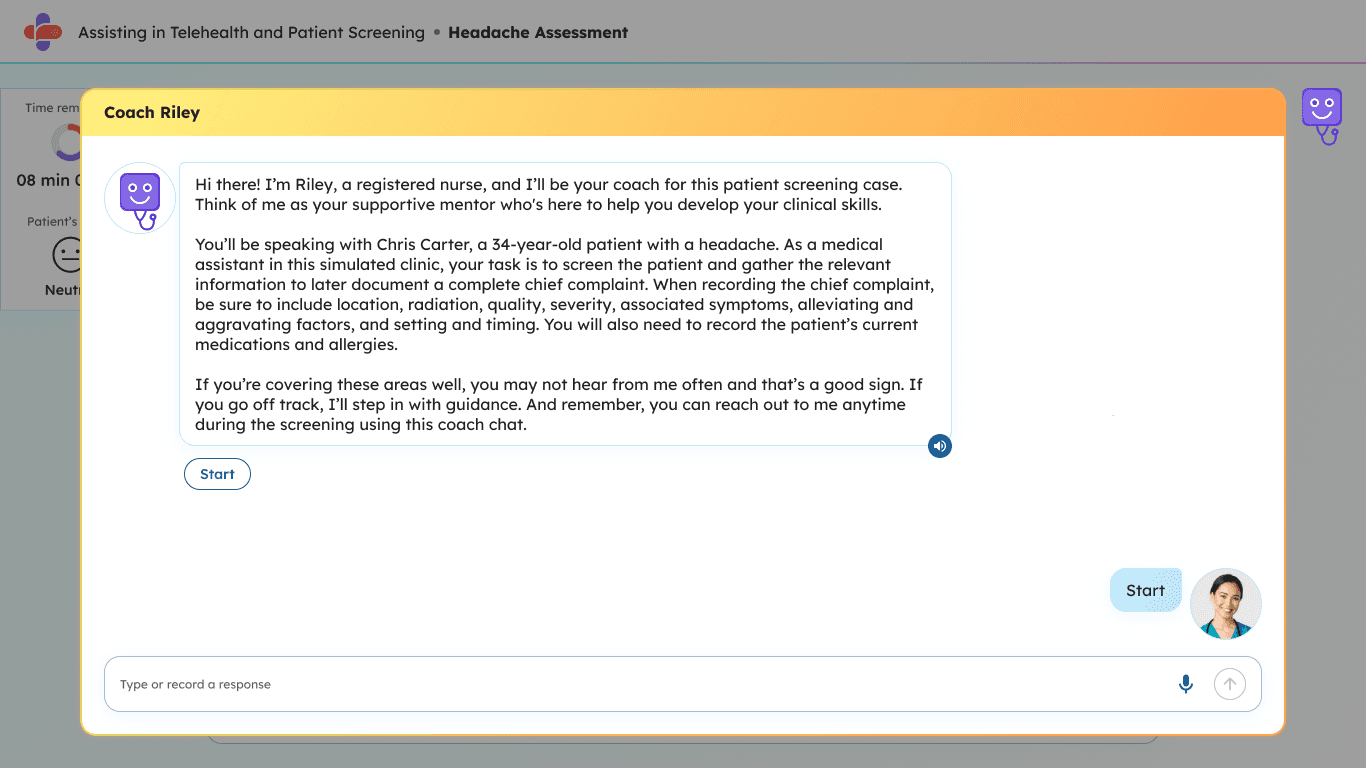
A registered nurse acting as a supportive mentor. Riley's first message to the student sets the tone for the entire experience:
"If you're doing well, you might not hear from me much — and that's great. If you look like you're off the path, I'll guide you with some hints."
The Three Learning Paths
Every student conversation is evaluated against a clinical rubric and routed into one of three paths:
Good Path — Riley stays quiet
The student asks the right questions in the right order - chief complaint, location, severity, associated symptoms, medications, allergies. The conversation flows naturally. Riley doesn't intervene. Her silence is the feedback.
Weak Path — Riley nudges, then teaches
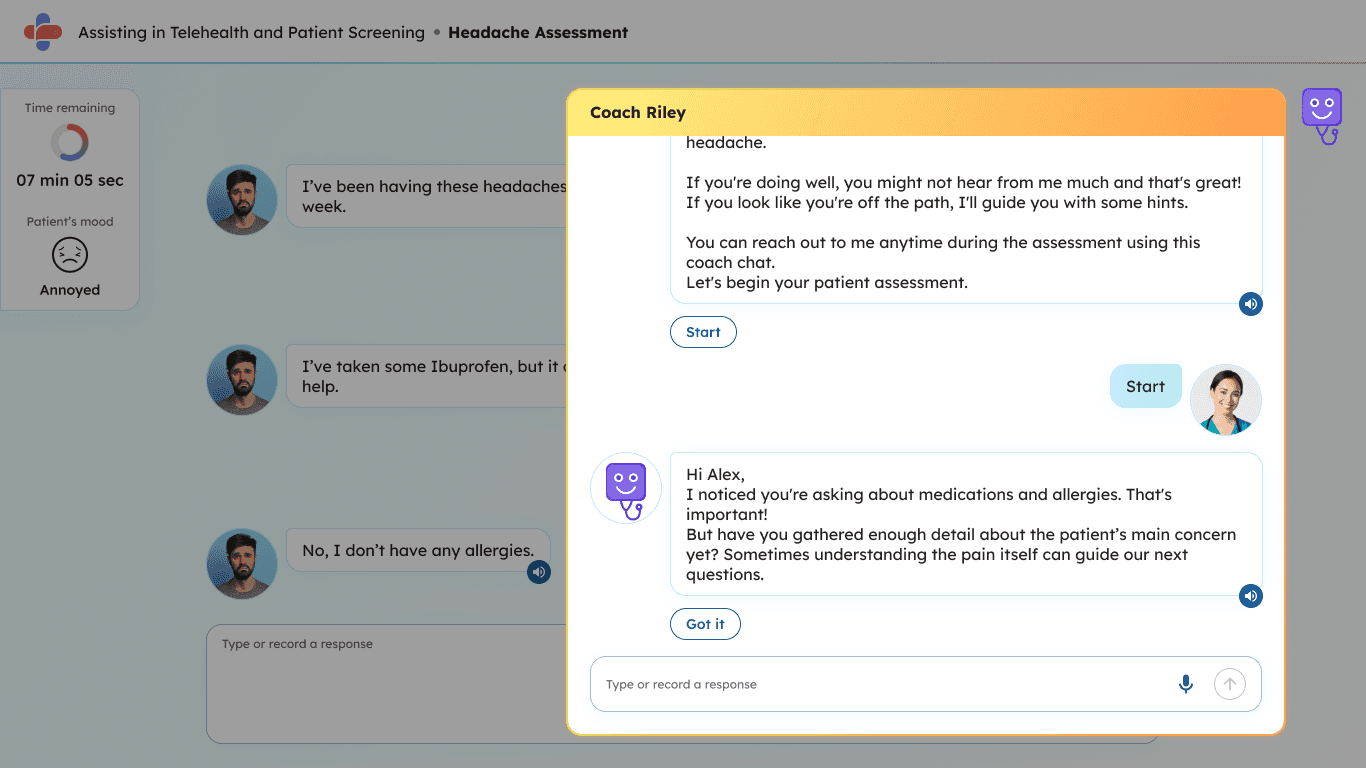
The student asks clinically relevant questions but in the wrong order — jumping to medications and allergies before fully exploring the chief complaint. After two exchanges, Riley surfaces a gentle inline prompt: "See what Coach Riley has to say." The student can tap it or keep going.
If the student self-corrects, Riley acknowledges the improvement and asks a Socratic reinforcing question — "Why do you think it was important to ask about the headache characteristics before exploring medications?" — with multiple choice options to deepen clinical reasoning.
If the student continues off-path despite the nudge, Riley ends the scenario and directs them to a relevant study resource before retrying.
Off Path — Riley redirects, then decides
The student asks questions irrelevant to the scenario entirely. Riley intervenes after two exchanges with a direct redirect. From there, the student either finds their way back (conversation continues normally) or persists off-track
Episode 4: Interface Design
The interface had to feel clinical without feeling cold.
The split layout keeps patient and coach conversations separate.
The patient chat is always primary, the coach panel overlays only when activated.
Key decisions:
Mood indicator - visible, not intrusive. Teaches affect-reading as a clinical skill.
Timer - present but not punitive. Creates realistic urgency without anxiety.
Voice + text input - mirrors real telehealth settingswhere both modes are standard.
Episode 5: The Outcomes
The POC is currently in review with Cengage stakeholders. The design delivered against the original brief. The POC demonstrated:
A viable pedagogical model combining virtual patient simulation with real-time AI coaching
A branching logic framework applicable to any clinical skill
A presence model for AI coaching that avoids the over-coaching problem common in tutoring tools
Episode 6: My Learnings
Copy is interaction design. Coach Riley's opening message iS the entire presence model in two sentences. Getting that copy right changed how the whole system felt.
The pedagogy has to lead. Before any UI decisions, I had to understand how clinical questioning is taught, what good order looks like, why sequence matters, what "off track" actually means in a patient intake. Domain understanding shaped every design choice.
Guidance doesn't have to mean control. You can have a strong coaching layer without making it feel like surveillance. The coach should be available, not mandatory.